
Professional Hair Extension Planning Guide
Why 200 Hair Extension Strands Do Not Always Give the Same Result
Two clients may both receive 200 hair extension strands, yet one result can look full, dense and luxurious while the other looks lighter with thinner ends. The difference is not only the number of strands. It is the combination of grams per strand, total gram weight, hair quality and length planning.
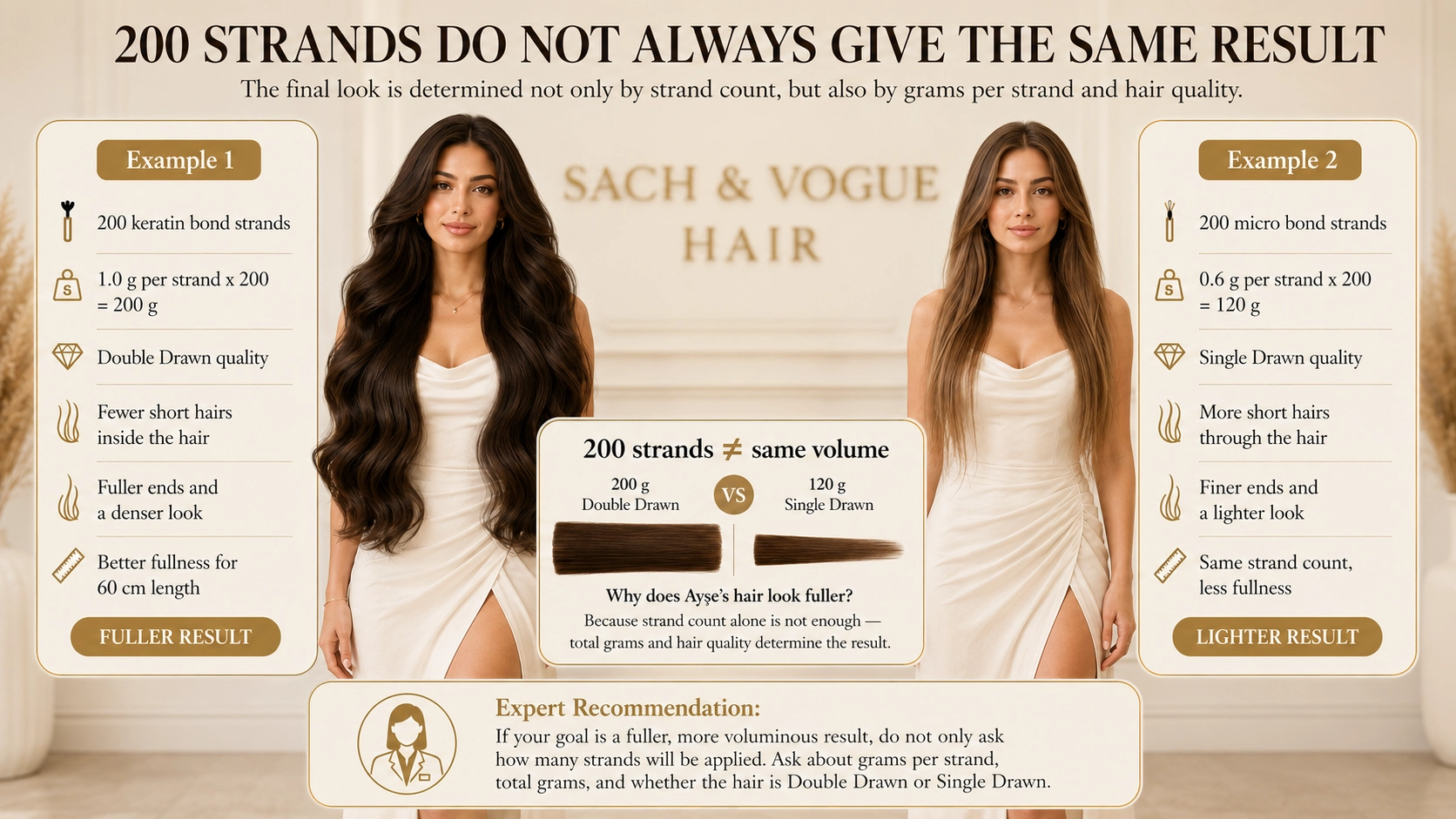
One of the most common questions in professional hair extension consultations is: “My friend Emma had 200 strands fitted and her hair looks beautifully full. I also had 200 strands fitted, but my result looks thinner and weaker at the ends. Why does mine not look like hers?”
This question is important because it reveals one of the biggest misunderstandings in hair extension planning. Many clients compare hair extensions only by strand count. They may ask for 150 strands, 180 strands or 200 strands and expect the same visual result as another person who received the same number. In reality, the number of strands is only one part of the equation.
At Sach & Vogue Hair, we believe a professional consultation should explain the complete structure behind the result. A beautiful extension result is not created by numbers alone. It is created by the right relationship between strand count, grams per strand, total gram weight, hair length, natural hair density and the quality of the extension hair.
Strand Count Is Not the Same as Total Hair Weight
The phrase “200 strands” sounds precise, but it does not tell the full story. A strand can be prepared in different weights. One keratin bond strand may weigh approximately 1.0 gram, while a micro bond strand may weigh approximately 0.6 gram. Both applications may use 200 strands, but the total amount of hair applied is very different.
For example:
- 200 strands x 1.0 gram = 200 grams of hair
- 200 strands x 0.6 gram = 120 grams of hair
The difference between these two applications is 80 grams. In hair extension work, 80 grams is not a small difference. It can completely change the final density, the fullness through the ends and the visual richness of the finished look.
This is why two clients may both say, “I had 200 strands,” but their results can look completely different. One client may actually be wearing 200 grams, while the other may be wearing only 120 grams.
The Emma Example: Same Strand Count, Different Result
Imagine Emma has 200 keratin bond strands applied. Each strand is prepared at approximately 1.0 gram. Her total extension weight is therefore around 200 grams. The hair used is Double Drawn quality, meaning the shorter hairs inside the bundle have been reduced, creating fuller mid-lengths and stronger ends.
Now imagine another client also has 200 strands applied, but the strands are micro bonds prepared at 0.6 gram each. Her total extension weight is around 120 grams. If the hair is also Single Drawn, the ends naturally appear finer because more short hairs remain inside the bundle.
Both clients received 200 strands. But visually, the results are not comparable:
- Emma: 200 strands x 1.0 gram = 200 grams, Double Drawn quality
- Second client: 200 strands x 0.6 gram = 120 grams, Single Drawn quality
The second client may feel disappointed and say, “I also had 200 strands, but my hair does not look like Emma’s.” Technically, the explanation is clear: she received less total hair weight and a different hair quality structure.
200 Strands Comparison Table
A comparison table makes the difference easier to understand. The strand count is identical, but the total gram weight and hair structure are not the same.
| Application Type | Strands | Gram per Strand | Total Weight | Hair Quality | Visual Result |
|---|---|---|---|---|---|
| Keratin Bonds | 200 | 1.0 g | 200 g | Double Drawn | Fuller, denser, stronger ends |
| Micro Bonds | 200 | 0.6 g | 120 g | Single Drawn | Lighter finish, thinner ends |
Double Drawn vs Single Drawn: Why Hair Quality Changes the Result
The second major factor is the structure of the hair itself. In professional hair extension terminology, Double Drawn and Single Drawn describe how full the hair remains from top to ends.
Double Drawn hair contains fewer short hairs inside the bundle. The shorter strands are reduced during preparation, so the hair remains fuller through the mid-lengths and ends. This creates a denser, more luxurious and more polished finish, especially in longer lengths such as 55 cm, 60 cm or more.
Single Drawn hair has a more naturally mixed structure. It contains a higher percentage of shorter hairs inside the bundle. This can create a softer and more natural taper, but the ends will usually look lighter compared with Double Drawn hair of the same length and weight.
Single Drawn hair is not necessarily bad. It can be suitable for clients who want a softer, lighter or more natural finish. However, if the client’s expectation is a dense, full, camera-ready result, then Single Drawn hair at a lower total gram weight may not deliver the look they imagined.
Why 60 cm Hair Needs More Careful Gram Planning
Length is another important factor. The longer the extensions are, the more carefully the total gram weight must be planned. A 120 gram application may look acceptable at a shorter length on some clients, but at 60 cm it may look light, especially through the ends.
Long hair distributes its weight over a greater distance. If there is not enough hair in the application, the ends can look thin or disconnected. This is especially noticeable when the client’s own hair is blunt, thick or shorter than the desired extension length.
For a fuller 60 cm result on average-density hair, 200 grams of well-prepared Double Drawn hair can create a much more substantial silhouette than 120 grams of Single Drawn hair. The difference is not only mathematical; it is visible in the final shape, movement and end density.
This is why a professional extension plan should always consider the desired length. A client asking for 200 strands at 45 cm is not the same as a client asking for 200 strands at 60 cm.
Not Sure How Many Grams You Need?
Send clear daylight photos of your natural hair and your desired result. Our team can help estimate the most suitable strand weight, total grams and hair quality for your target length and fullness.
Micro Bonds Can Be Beautiful, But the Weight Must Be Planned Correctly
Micro bond or micro capsule applications are often chosen for a more discreet and delicate result. Smaller bonds can be useful around finer areas, around the face, or for clients who need a more refined attachment point. However, smaller bonds usually contain less hair per strand.
This means the client must not compare micro bond strand count directly with standard keratin bond strand count. If a micro bond contains 0.6 gram and a standard keratin bond contains 1.0 gram, the same number of strands will not create the same amount of hair.
Micro bonds can still create a full result, but the planning must be adjusted. The stylist or supplier must calculate the total grams required for the target look. If the client wants fullness, the question should not be “How many pieces?” only. It should be “How many total grams will give the correct result for this length and natural hair density?”
For a broader overview of keratin-based methods, read our Keratin Hair Extensions guide and our Micro Capsule Keratin Hair Extensions guide.
The Two-Layer Difference: Gram Weight and Drawn Quality
The most important lesson is that a lighter result can come from two different layers at the same time.
The first layer is gram weight. If one person receives 200 grams and another receives 120 grams, the final density will not be the same. The second layer is drawn quality. If one person receives Double Drawn hair and another receives Single Drawn hair, the ends will not look the same.
When these two factors combine, the difference becomes even more visible. A 200 gram Double Drawn application can look dense, full and luxurious. A 120 gram Single Drawn application can look lighter, finer and less full, even if the strand count is the same.
This is exactly why clients should avoid judging hair extension plans by strand count alone.
What Should You Ask Before Booking Hair Extensions?
Before choosing an extension plan, clients should ask more precise questions. A professional consultation should explain not only the number of strands, but also the total weight and quality structure of the hair.
Important questions include:
- How many grams is each strand?
- What will be the total gram weight?
- Is the hair Double Drawn or Single Drawn?
- Is the selected weight suitable for the desired length?
- Will the ends look full enough for my natural hair density?
- Is my desired result natural, medium-full or very full?
- Does my own hair require more grams to blend properly?
These questions help prevent disappointment. They also allow the stylist to create a more honest plan based on the client’s real expectations.
Expert Recommendation
If your goal is a fuller and more voluminous result, do not focus only on how many strands will be applied. Ask about grams per strand, total grams, the selected hair quality and whether the hair is Double Drawn or Single Drawn.
A professional extension plan should be based on the result you want, not only on a fixed number. If you want a rich 60 cm look with strong ends, the application may need more total grams and a fuller hair structure. If you want a lighter and more natural finish, a lower total gram plan may be suitable.
There is no single number that fits every client. The correct amount depends on natural hair density, head size, desired length, desired fullness, application method and hair quality.
Sach & Vogue Hair Approach
Sach & Vogue Hair prepares premium human hair extensions with attention to colour, length, method, gram planning and final result. Our approach is not to sell a number of strands without context. Instead, we help clients and professionals understand what that number actually means.
For private clients, this means more realistic expectations. For salons and professional buyers, it means better planning, better client satisfaction and fewer misunderstandings. A client who understands the difference between 200 strands and 200 grams is much more likely to choose the correct application plan.
When a client says, “I want my hair to look like Emma’s,” the professional answer should be: let us examine the length, total grams, drawn quality and natural hair density. Only then can we plan a result that is truly comparable.
Need Help Planning the Right Gram Weight?
If you are unsure whether you need 120 grams, 150 grams, 200 grams or more, send clear daylight photos of your natural hair and your desired result. Our team can guide you toward a more accurate plan based on your extension method, colour, length and fullness goal.
Create Your Order
Private Order Hair Extensions
Professional Access
Contact Sach & Vogue Hair
FAQ
Do 200 hair extension strands always give the same result?
No. The result depends on grams per strand, total grams, hair quality, extension length and natural hair density. 200 strands can mean 200 grams or 120 grams depending on how each strand is prepared.
Why does my friend’s 200-strand hair look fuller than mine?
Your friend may have received heavier strands, a higher total gram weight or Double Drawn hair. If your strands are lighter or Single Drawn, the final result can look less full even with the same strand count.
What is the difference between 200 grams and 120 grams?
The difference is 80 grams of hair. In longer applications, especially around 60 cm, this can make a major difference in fullness, movement and end density.
Is Double Drawn hair better than Single Drawn hair?
Double Drawn hair is usually better for clients who want fuller ends and a denser luxury result. Single Drawn hair can still be suitable for a softer or more natural finish.
Are micro bonds always lighter than keratin bonds?
Micro bonds are often prepared in smaller gram weights, such as 0.6 gram per strand. This can make the application more discreet, but the total grams must be planned carefully if the client wants fullness.
How many grams do I need for a full 60 cm result?
The ideal amount depends on your natural hair density and desired fullness. Many clients need a higher total gram plan for a fuller 60 cm result, especially if they want dense ends and a luxury finish.