
Sach & Vogue Hair • Professional Education
Why Does Nanofilament Hair Extensions Take Longer?
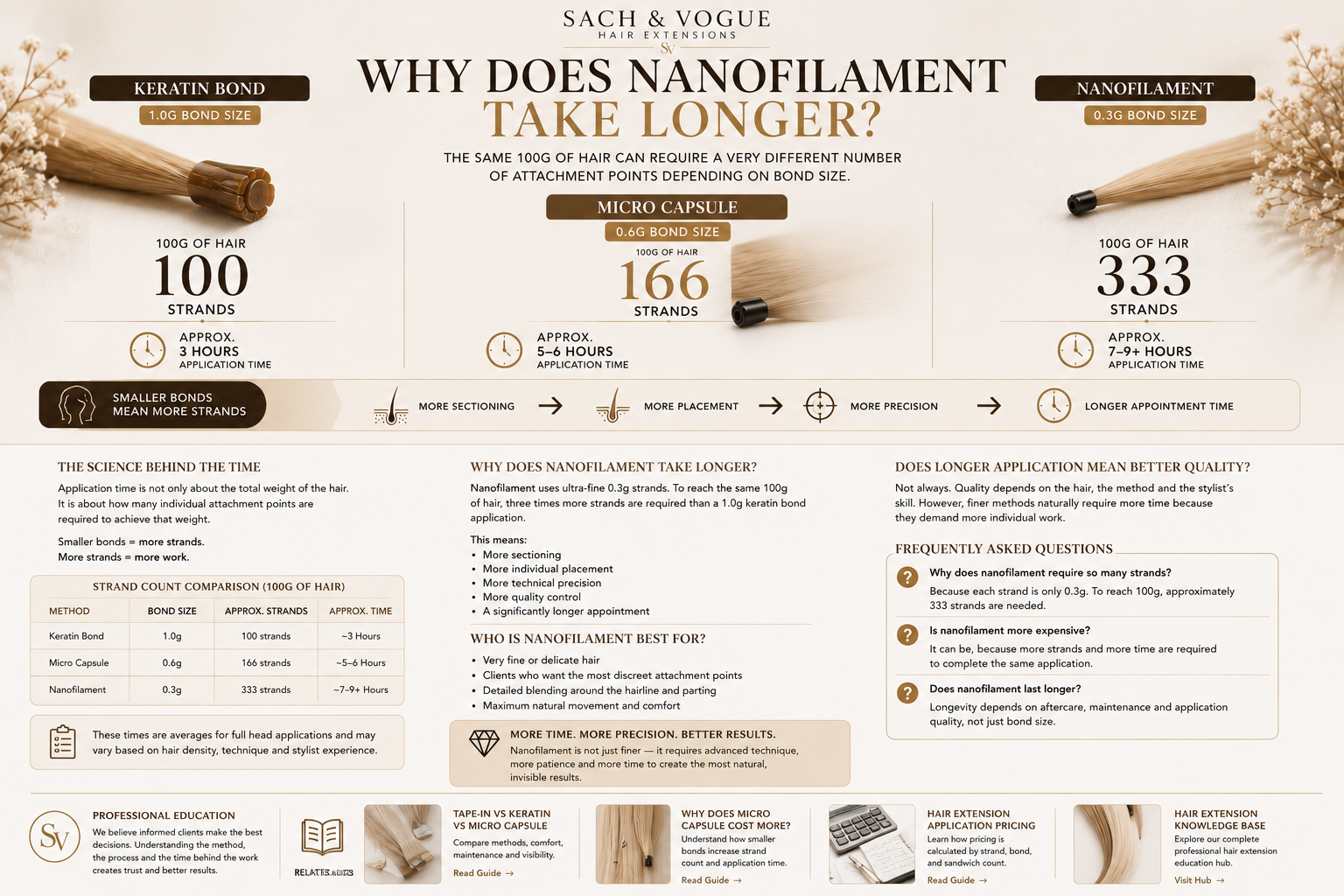
Smaller strand sizes require significantly more attachment points, increasing application time and technical precision.
Many clients assume that 100g of hair extensions should require the same amount of work regardless of the method used. In reality, application time is often determined by the number of individual strands rather than total weight alone.
The Hidden Factor Behind Application Time
The total weight of hair is only one part of the equation. Professional hair extension specialists must also consider the number of individual attachment points required to achieve that weight.
Smaller bonds mean more strands. More strands mean more work.
Strand Count Comparison For 100g Of Hair
| Method | Bond Size | Approx. Strands | Approx. Application Time |
|---|---|---|---|
| Keratin Bond | 1.0g | 100 strands | ~3 Hours |
| Micro Capsule | 0.6g | 166 strands | ~5–6 Hours |
| Nanofilament | 0.3g | 333 strands | ~7–9+ Hours |
Attachment Points For 100g Of Hair
The same 100g of hair can require a very different number of attachment points depending on the method. Smaller bonds require more individual strands, which increases application time and technical work.
Example based on approximate strand weight. Final strand count and appointment time may vary depending on hair density, product structure, placement plan and professional consultation.
Why Does Nanofilament Require So Many Strands?
Nanofilament systems use ultra-fine strands, often around 0.3g per attachment point. To achieve the same 100g total weight, significantly more strands are required compared with standard keratin systems.
A standard 1.0g keratin application may require approximately 100 strands. A nanofilament application may require approximately 333 strands for the same weight.
What Creates The Additional Time?
Every strand must be:
- Sectioned correctly
- Placed individually
- Attached securely
- Checked for balance and comfort
- Integrated into the overall design
When strand count triples, the amount of technical work increases dramatically.
Why Hair Weight Alone Can Be Misleading
Many clients compare extensions by grams alone. However, professional application planning requires understanding both total weight and strand count.
A 100g application can require 100 strands, 166 strands or 333 strands depending on the chosen system.
For this reason, experienced hair extension specialists often calculate application complexity using both weight and attachment count.
Does Longer Application Mean Better Quality?
Not necessarily.
Nanofilament is not automatically better than keratin or micro capsule. It is simply a finer system that allows smaller attachment points and more detailed placement.
The best method depends on hair density, styling habits, maintenance expectations and consultation goals.
Who Is Nanofilament Best For?
- Very fine or delicate hair
- Clients who want the smallest attachment points possible
- Hairline and parting area work
- Maximum blending and discretion
- Clients willing to invest more appointment time
Real-World Application Logic
The attachment process itself is similar regardless of strand size. The reason nanofilament takes longer is not because each strand is more difficult to apply.
The reason is simple:
More strands require more sectioning, more placement and more precision.
Frequently Asked Questions
Why does nanofilament require more strands?
Because each strand contains less hair. More strands are needed to achieve the same total weight.
Is nanofilament more expensive?
It can be, because more application time and technical work are required.
Does nanofilament last longer?
Longevity depends on maintenance, aftercare and application quality rather than bond size alone.
Is nanofilament suitable for every client?
Not always. Nanofilament is most useful for very fine hair, visible areas and clients who need highly detailed, discreet placement.