
Professional Fusion Extension Guide
Keratin Hair Extensions
A complete professional guide to keratin bond types, strand weight, gram planning, application, maintenance, lifespan, removal and natural-looking results.
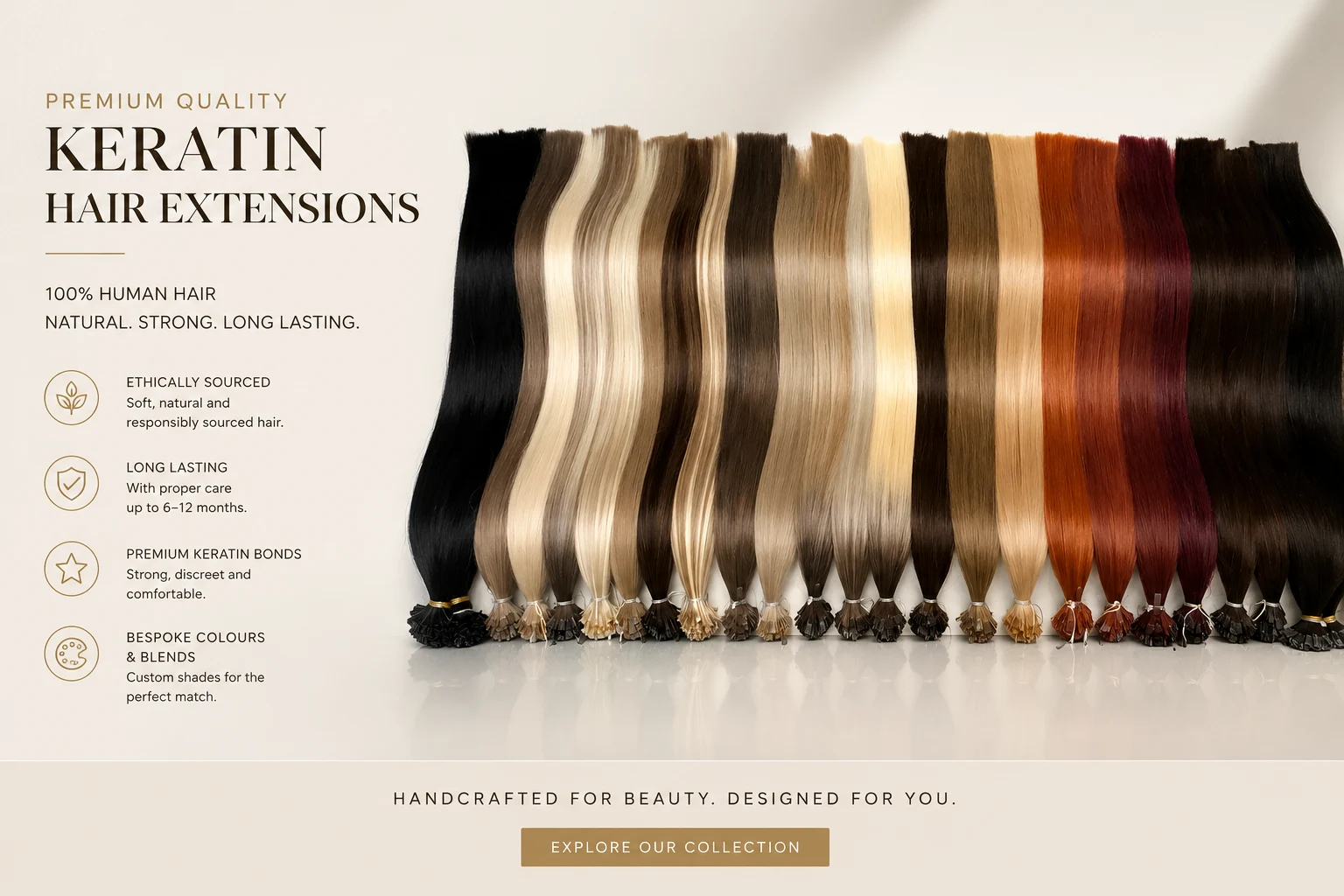
Premium Human Hair Extensions
Keratin hair extensions remain one of the most trusted professional methods for creating natural-looking length, volume and colour dimension. Each extension strand is applied individually, allowing the stylist to control placement, density and movement with far greater precision than many temporary systems.
At Sach & Vogue Hair, we have manufactured premium human hair extensions since 2011 for professional salons, hair extension specialists and private clients worldwide. Our keratin extensions are prepared in different bond shapes, lengths and colour combinations to suit a wide range of application plans.
What Are Keratin Hair Extensions?
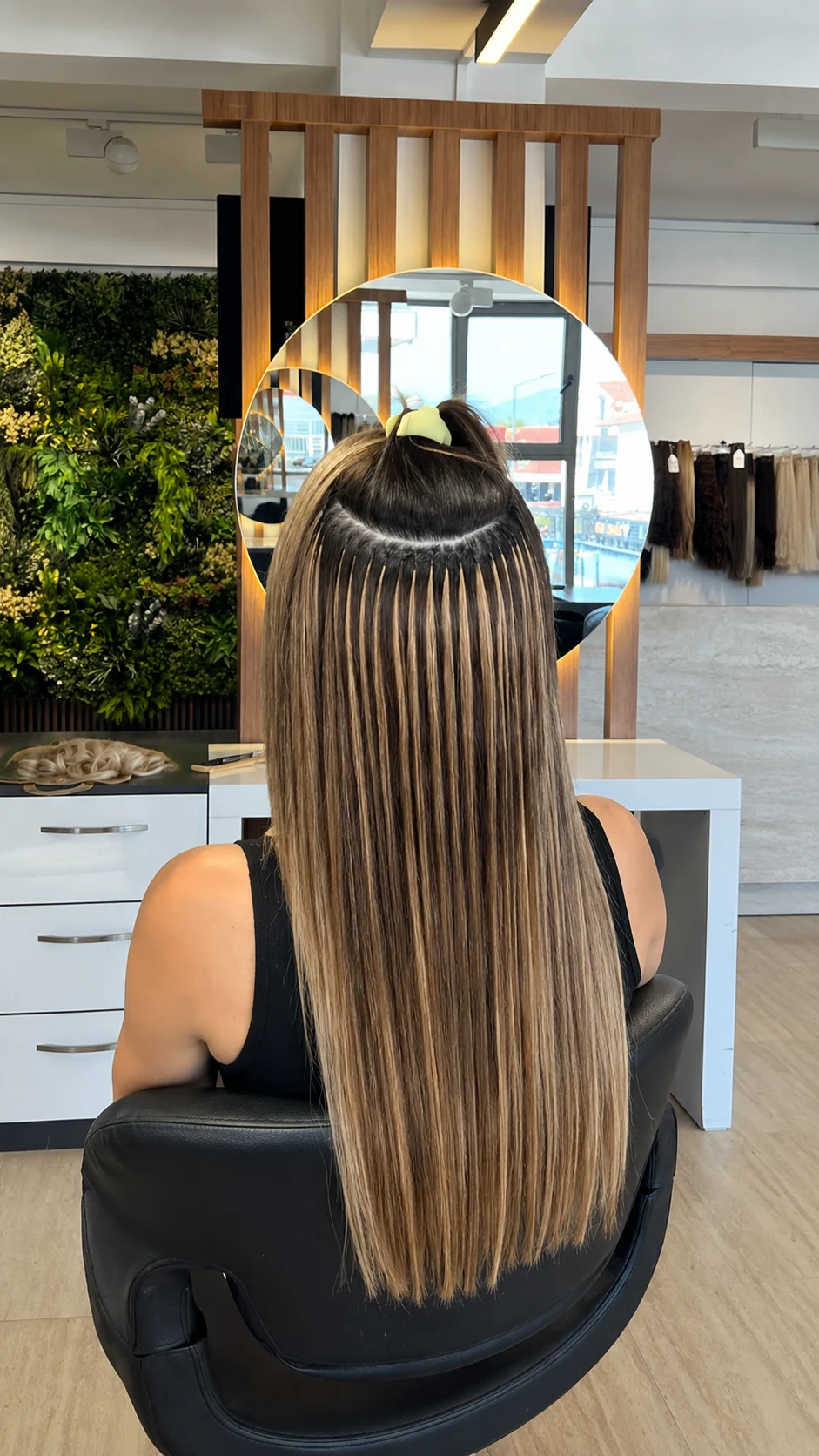
Keratin hair extensions are individual strands of human hair pre-bonded with a professional fusion adhesive. During installation, the bond is softened with a specialised heat tool and shaped around a small, carefully selected section of the client's natural hair.
Once cooled, the bond becomes secure yet flexible. The extension then moves with the client's own hair and can remain discreet even when the hair is worn up, provided the placement has been planned correctly.
The term “keratin” in this context refers to the professional bonding material used for extension installation. It is not the same as a keratin smoothing or straightening treatment.
Why Choose Keratin Hair Extensions?
Precision placement
Individual strands allow detailed placement around the sides, back, crown and face frame.
Natural movement
Each bond moves independently, creating a result that behaves more like natural hair.
Long wear
With correct application and care, keratin extensions provide a secure semi-permanent result.
Custom colour design
Multiple shades can be distributed strand by strand for highlights, lowlights and dimension.
Keratin extensions are especially suitable for clients seeking:
- Natural-looking length and volume
- A discreet attachment method
- Flexible styling options
- Detailed colour placement
- A professional result designed for daily wear
Keratin Bond Types
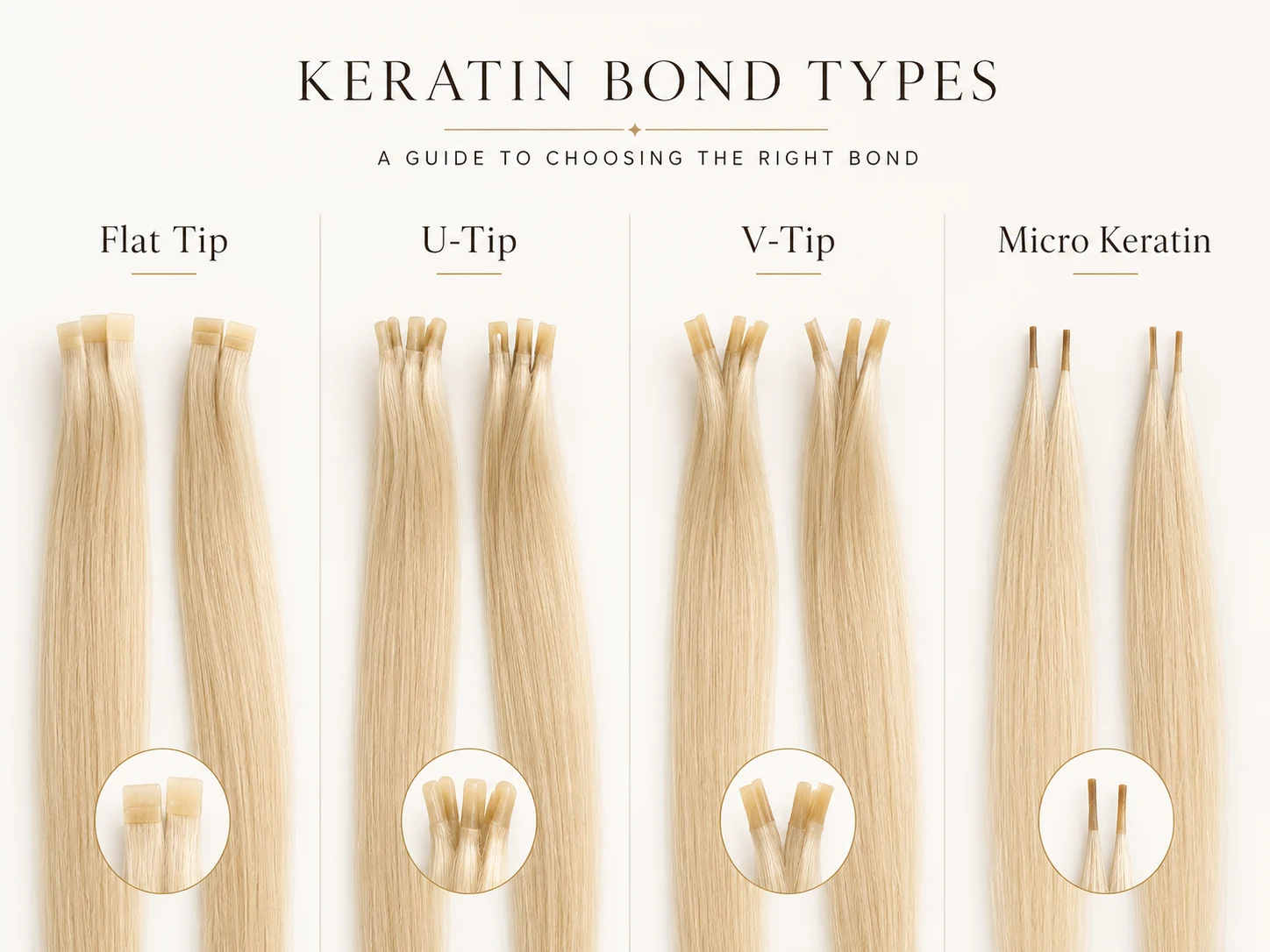
Flat Tip
A wide, slim bond that can be divided or reshaped during professional application.
U-Tip
A traditional fusion shape designed to wrap around the natural section during installation.
V-Tip
A precise, versatile format preferred by many specialists for controlled bond formation.
I-Tip
A narrow tip commonly used with ring-based cold application rather than melted fusion.
| Bond type | Typical use | Key advantage |
|---|---|---|
| Flat Tip | Hot fusion | Easy to reshape and customise |
| U-Tip | Traditional hot fusion | Reliable, familiar professional format |
| V-Tip | Precision hot fusion | Controlled bond formation |
| I-Tip | Micro-ring or cold application | No melting during installation |
Why Italian Keratin Quality Matters
Not all fusion adhesives perform the same way. Professional Italian keratin is valued for its balance of adhesion, flexibility and clean removal.
High-quality keratin can provide:
- More reliable attachment
- Better flexibility after cooling
- Cleaner bond shaping
- Reduced brittleness
- More controlled professional removal
- Less unnecessary residue
Inferior adhesives may become brittle, crack prematurely, soften excessively or leave heavy residue. For this reason, the bond material should be evaluated with the same care as the hair itself.
Professional Planning Principle
Strand Count Alone Does Not Tell You How Much Hair You Are Buying
Always calculate strand count together with the weight of each strand. One hundred 0.8 gram strands equal approximately 80 grams of hair. A supplier offering lighter strands may advertise the same number of pieces while providing significantly less total hair.
How Many Grams of Keratin Hair Extensions Do You Need?
The correct weight depends on natural density, current haircut, target length and whether the goal is volume, length or a complete transformation.
| Natural hair density | Typical planning range | Common goal |
|---|---|---|
| Very sparse or fine | 100–150 g | Volume or controlled length |
| Normal density | 150–180 g | Balanced full-head transformation |
| Denser than normal | 180–220 g | Longer, fuller blending |
| Very dense or blunt short hair | 220–250+ g | Complete length transformation |
How Many Keratin Strands Are Required?
Our standard keratin strands are approximately 0.8 grams each. This means strand count can be estimated from the planned total weight.
| Total weight | Approximate number of 0.8 g strands |
|---|---|
| 80 g | 100 strands |
| 100 g | 125 strands |
| 120 g | 150 strands |
| 150 g | 188 strands |
| 180 g | 225 strands |
| 200 g | 250 strands |
A volume-only application may use fewer strands, while a major short-to-long transformation can require 200 or more. The exact figure should be planned according to density and haircut.
Keratin Extensions for Short Hair
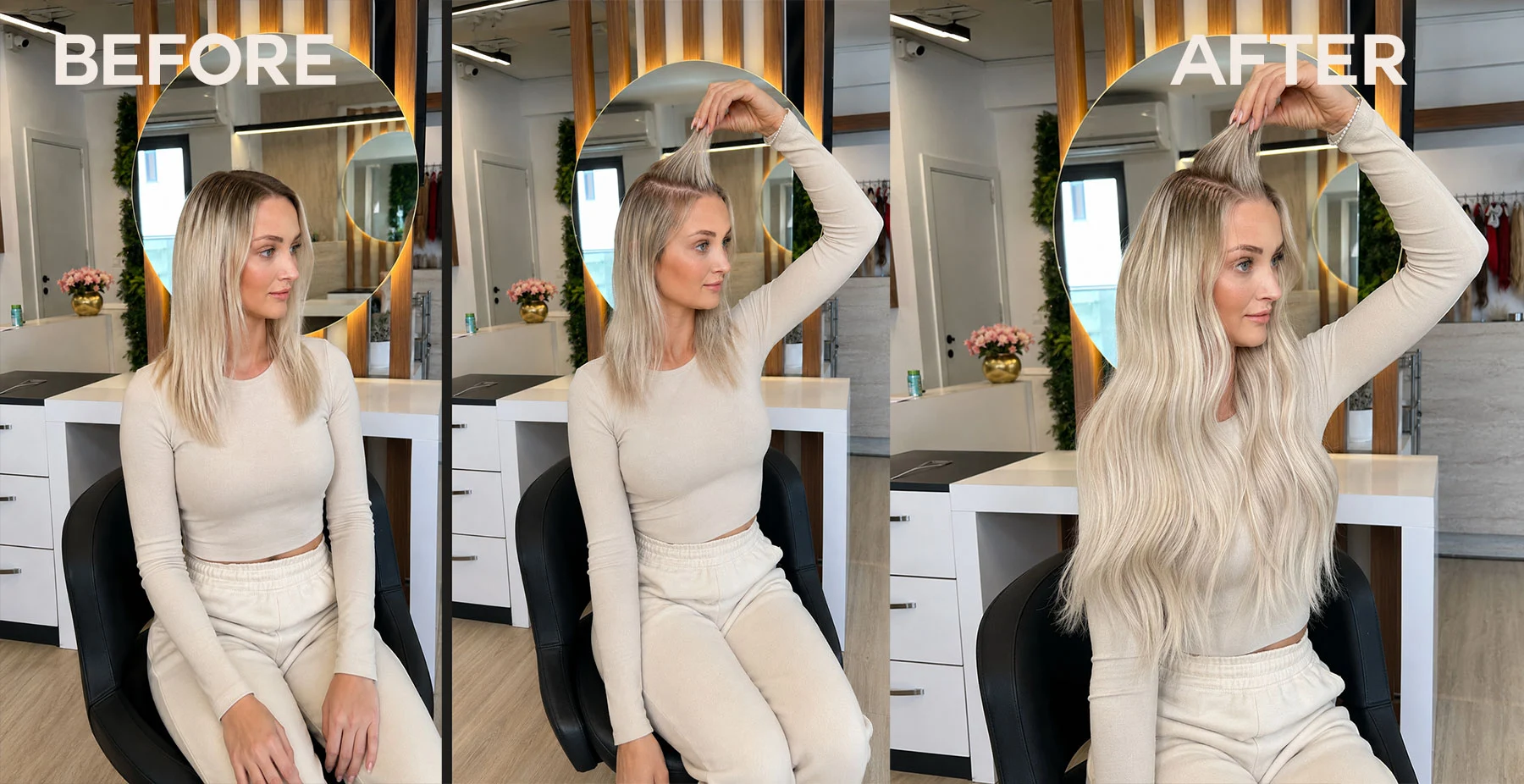
Short hair can be transformed successfully with keratin extensions, but the application requires more strategic planning than a conventional volume service.
The stylist must build enough density to hide the short natural perimeter and distribute the extensions high enough to create continuity without exposing the bonds.
Important considerations include:
- Natural hair must be long enough to cover the bonds
- Blunt or very dense ends usually require more grams
- The application should extend close to, but not into, the visible parting area
- Too little hair creates a shelf between natural hair and extensions
- Correct cutting and blending after installation are essential
How Keratin Hair Extensions Are Applied
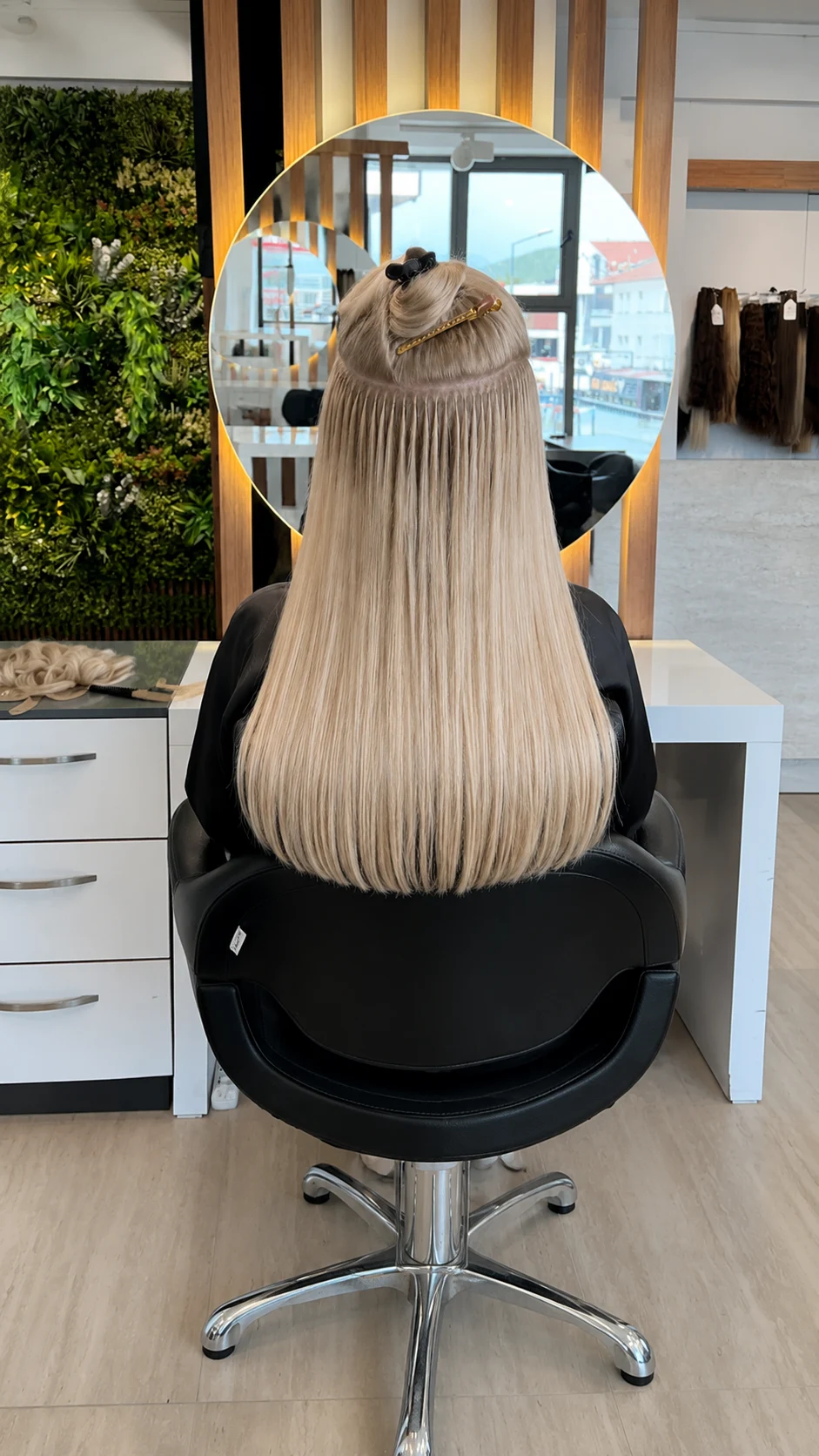
Consultation and planning
The stylist assesses hair condition, density, colour, target length and required weight.
Hair preparation
The natural hair is washed with a suitable clarifying product and dried without oils or heavy conditioner.
Sectioning
Clean horizontal sections are created while respecting the hairline, parting and movement zones.
Bond application
Each keratin tip is softened with the fusion tool and shaped around a correctly sized natural section.
Distribution check
The stylist checks balance, comfort, bond spacing and visual density throughout the head.
Cutting and blending
The completed extensions are shaped so the natural haircut and added hair form one seamless silhouette.
Correct Bond Placement and Weight Distribution
A successful installation is not simply about attaching as many strands as possible. Every bond must be matched to a natural section strong enough to carry it.
Professional placement should avoid:
- Oversized bonds on very fine natural hair
- Natural sections that are too small for the extension weight
- Attachment too close to the scalp
- Placement inside visible hairlines or partings
- Uneven distribution that leaves heavy zones
Balanced placement helps the extensions move naturally and reduces unnecessary tension on the client's own hair.
How Long Do Keratin Hair Extensions Last?
A professional keratin application commonly remains in place for approximately three to four months. The exact wear period depends on:
- Natural hair growth speed
- Bond quality
- Application technique
- Home care
- Brushing habits
- Use of oils, masks and heat
- Natural hair condition
The hair itself may last longer than one installation and can sometimes be rebonded and reused when it remains in good condition.
Keratin Hair Extension Aftercare
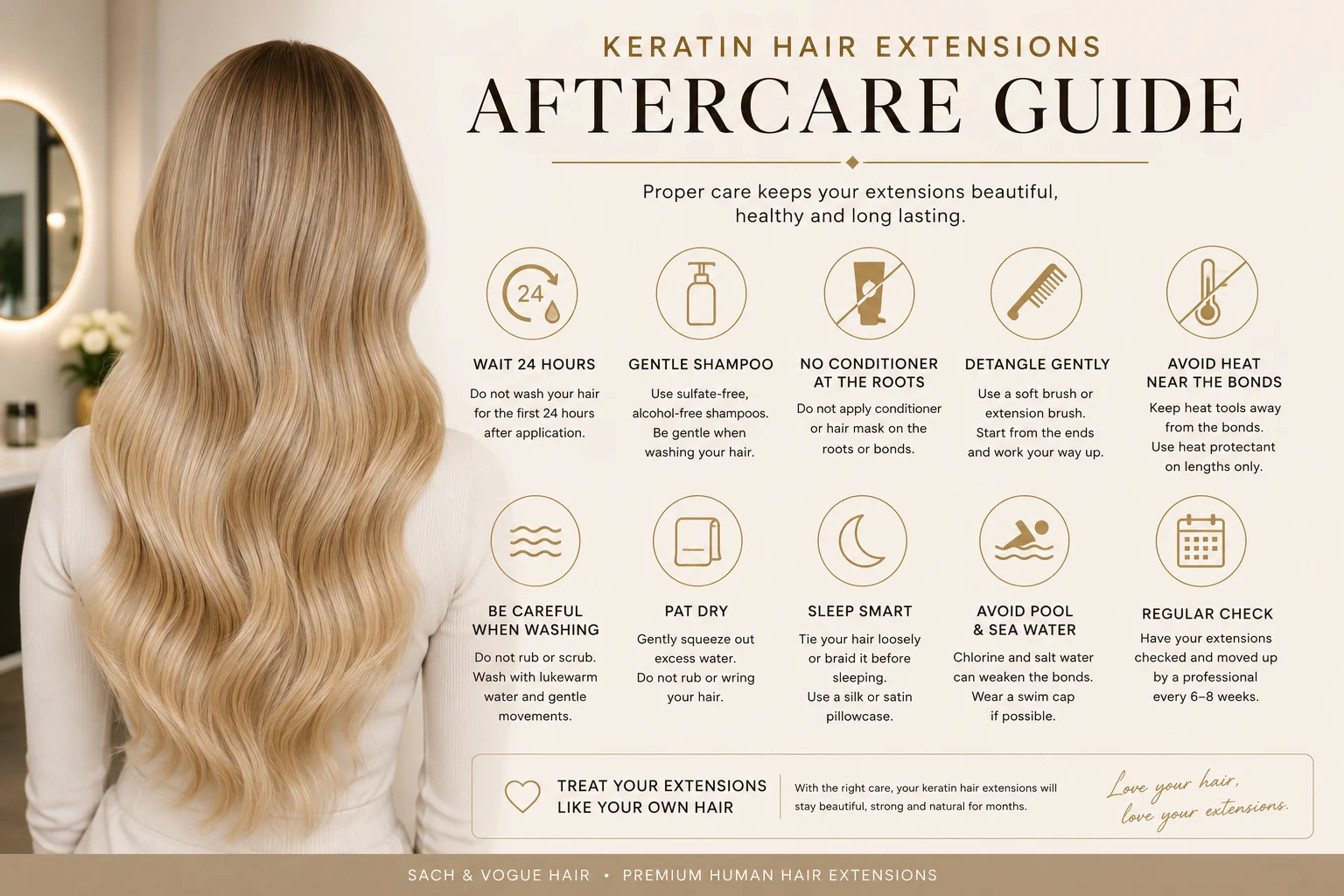
Daily care directly affects bond security and hair longevity.
- Brush gently from the ends upward while supporting the roots
- Use an extension-safe brush
- Separate the bonds regularly with your fingers
- Keep oils, masks and conditioner away from the attachment area
- Dry the root and bond area fully after washing
- Sleep with dry hair in a loose braid or low ponytail
- Avoid pulling or aggressive backcombing near the bonds
- Use heat protection on the lengths
How to Wash Keratin Hair Extensions
- Detangle the hair before entering the shower.
- Wash in an upright position rather than flipping the hair forward.
- Apply shampoo gently between the rows without rubbing the bonds together.
- Rinse thoroughly.
- Apply conditioner and mask only to the mid-lengths and ends.
- Press out excess water without twisting.
- Dry the scalp and bonds completely before leaving the lengths damp.
Professional Removal and Reuse
Keratin extensions should be removed by a trained professional using a suitable bond remover and extension tool. The bond is softened, broken down and gently released without pulling the natural hair.
Incorrect removal can cause:
- Breakage
- Unnecessary shedding
- Tangling at the root
- Damage from forceful pulling
After removal, reusable hair can be cleaned, trimmed and fitted with new keratin before reapplication. Whether reuse is appropriate depends on the condition of the hair.
Common Keratin Extension Mistakes
Using sections that are too small
The natural section must be strong enough to support the extension strand.
Using sections that are too large
Oversized sections prevent correct bond closure and reduce flexibility.
Applying too close to the scalp
This can cause discomfort and restrict natural movement.
Insufficient total weight
Too few grams can leave visible separation between short natural hair and the extensions.
Oil at the attachment area
Oils and heavy conditioning products can weaken adhesion and encourage slippage.
Incorrect removal
Pulling, twisting or cutting bonds without control can damage natural hair.
Keratin Extensions vs Other Methods
| Method | Attachment | Best known for |
|---|---|---|
| Keratin | Individual fusion bonds | Precision, movement and long wear |
| Tape-In | Flat adhesive panels | Fast application and flat attachment |
| Micro Capsule | Very small individual bonds | Fine-detail placement and discreet zones |
| Weft | Sewn or ring-supported rows | High density and efficient volume |
| Clip-In | Temporary clips | Removable volume and length |
Frequently Asked Questions
How many keratin strands do I need for a full head?
A full application often requires approximately 150 to 250 strands, depending on strand weight, natural density, haircut and target length.
How much does one keratin strand weigh?
Our standard keratin strand is approximately 0.8 grams unless another custom specification is requested.
How long does the application take?
A full application commonly takes several hours. The time depends on strand count, bond size, placement complexity and whether cutting and styling are included.
Can keratin extensions damage natural hair?
Correctly selected, applied and maintained extensions should not damage healthy natural hair. Risk increases with poor sectioning, excessive weight, neglect or improper removal.
Can keratin extensions be reused?
Yes, the hair can often be rebonded when it has been maintained well and remains in suitable condition.
Can I colour keratin hair extensions?
It is better to order the correct colour from the beginning. Additional chemical processing can shorten the life of the hair and should only be performed by an experienced professional after a strand test.
Can I use heat styling tools?
Heat may be used on the lengths with protection, but direct contact with the keratin bonds should be avoided.
How should I sleep with keratin extensions?
Sleep with completely dry hair in a loose braid or low ponytail to reduce tangling and friction.
Professional Order Planning
Choose the Correct Colour, Length and Gram Weight
Send clear daylight photographs of your natural hair. Our specialists can help assess colour, density, target length and the approximate number of keratin strands required.