
Professional Planning Guide
Hair Extension Weight Guide: How Many Grams Do You Really Need?
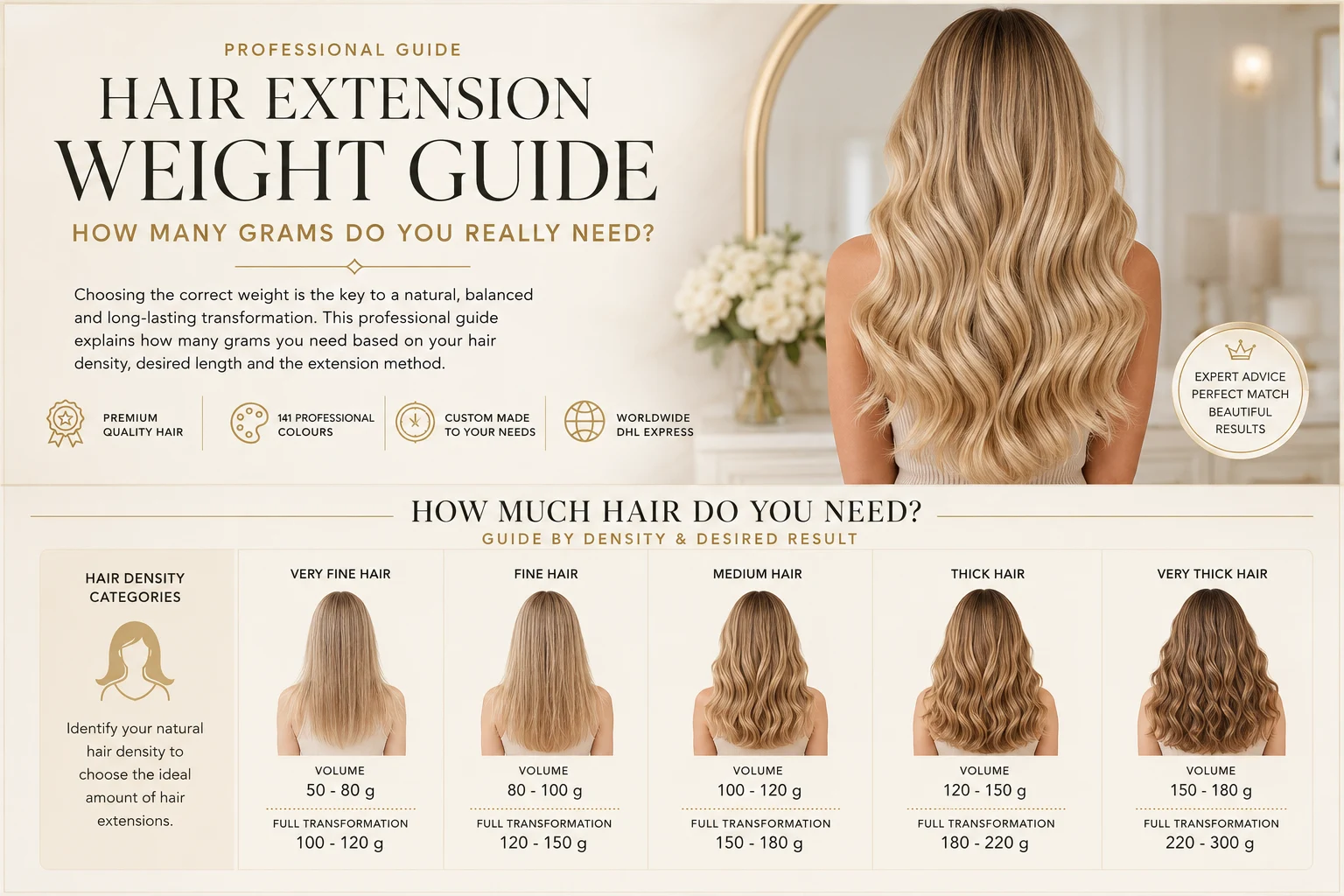
The correct gram weight is determined by your natural hair density, current length, desired result and chosen extension method. This manufacturer-led guide explains how to select enough hair for a balanced, seamless transformation without adding unnecessary weight.
The foundation of a natural result
Why Hair Extension Weight Matters
Hair extensions are often sold by packs, strands or pieces, but the most reliable way to understand how much hair you are buying is the total weight in grams. The number of attachments describes how the hair is divided. It does not, by itself, describe the final density.
Two clients may choose the same length and the same colour but require completely different weights. A client with very fine natural hair may achieve a full transformation with a moderate amount, while a client with dense, blunt-cut hair may need substantially more to blend the natural baseline into the extensions.
Understanding the numbers
Grams, Packs and Pieces Are Not the Same Thing
Grams
Grams measure the actual quantity of extension hair. This is the most useful number when comparing fullness, planning colour combinations and estimating the final result.
Pieces or Strands
Piece count explains how the total weight is divided into attachments. One hundred keratin strands can weigh very differently depending on whether each strand is 0.5 g, 0.8 g or 1 g.
Packs
A pack is a commercial unit, not a universal measurement. Always check the weight of one pack before deciding how many packs you require.
Visual Density
The final appearance also depends on length, end density, texture, layering and the relationship between the extensions and the client’s natural haircut.
A simple visual scale
What Different Gram Weights Usually Represent
Step one
Identify Your Natural Hair Density
Density is more important than the circumference of a ponytail alone. Professional planning also considers the amount of hair at the sides, the density through the crown, the thickness of the ends and whether the current haircut is layered, tapered or blunt.
Very Sparse or Very Fine Hair
The scalp may be more visible and the ends may be light. The objective is usually to create soft fullness without overloading delicate natural hair.
Normal Density
This is the most common category. The hair is neither particularly sparse nor unusually dense, and a balanced full-head transformation can often be achieved within a moderate gram range.
Denser Than Normal
More extension hair is required to match the stronger baseline, especially when adding substantial length. Too little weight can create a visible step between the natural hair and the extensions.
Very Dense Hair
Thick, blunt or compact natural hair generally needs a high gram weight and careful distribution. The aim is to continue the density through the new length rather than allowing it to disappear below the shoulders.
Professional starting ranges
Recommended Hair Extension Grams by Density
The ranges below are planning guidelines, not fixed promises. The exact recommendation changes with natural length, desired extension length, haircut, texture and method. For the common 60–65 cm transformation, our practical starting ranges are:
| Natural Hair Density | Volume Only | Length + Volume | Professional Comment |
|---|---|---|---|
| Very sparse / very fine | 50–100 g | Approximately 130–150 g | Use controlled placement and avoid unnecessary attachment weight. |
| Normal density | 80–120 g | Approximately 160–170 g | A frequent range for balanced 60–65 cm transformations. |
| Denser than normal | 100–150 g | Approximately 200–220 g | Extra weight is needed to continue the natural density through the added length. |
| Very dense / blunt hair | 120–180 g | Approximately 230–250 g or more | High density and short blunt cuts may require additional customised planning. |
These figures are based on professional transformation planning and may be adjusted after reviewing clear photographs of the client’s natural hair.
Step two
Why Longer Extensions Usually Need More Grams
As length increases, the same amount of hair is distributed over a greater distance. A weight that appears full at 40 cm can look much lighter at 65 or 70 cm. Longer transformations therefore require either more grams, stronger end density or both.
30–40 cm
Suitable for volume, modest length changes and shorter natural hairstyles. Lower gram weights can produce a visibly full result when the natural hair already has sufficient length.
45–55 cm
A versatile range for everyday transformations. The correct amount still depends heavily on natural density and haircut shape.
60–65 cm
A popular long-hair choice. Normal-density hair commonly needs around 160–170 g, while dense hair may need 200 g or more.
70 cm
Additional weight is often required to prevent thin-looking ends, particularly when the natural hair is short or blunt.
80 cm
Very long extensions require high density and careful planning. The same gram weight will look visually lighter than it does at shorter lengths.
85–90 cm
These are specialist lengths. Availability, natural-hair suitability, density and maintenance expectations should be assessed individually.
Step three
How Weight Planning Changes by Extension Method
1
Tape-In Hair Extensions
Tape-ins distribute hair across flat sections. A 50 g pack may contain 20 pieces, while 100 g may contain 40 pieces depending on the system. Total grams should be selected first; tape width and placement are then planned around the client’s head shape.
2
Keratin Hair Extensions
Keratin systems divide the total weight into individual strands. For example, a 0.8 g strand means that 100 strands equal approximately 80 g. Piece count must therefore always be translated into total grams.
3
Micro Capsule Hair Extensions
Micro capsules are often prepared at approximately 0.5–0.6 g per strand. A high strand count can still represent a moderate total weight, which is why grams remain the more meaningful planning figure.
4
Machine Weft Hair
Weft is particularly suitable for exact gram ordering. Clients may choose standard 100 g packs or request weights such as 120 g, 150 g, 180 g or 220 g according to their density and transformation plan.
5
Clip-In Hair Extensions
Clip-ins need enough density to blend as a removable set. Our seven-piece sets increase in weight with length: approximately 160 g at 40 cm, 200 g at 50 cm, 220 g at 60 cm, 280 g at 70 cm and 340 g at 80 cm.
6
U-Clip and U-Part Hair
These pieces cover a broad section and generally require substantial density. A U-Clip piece usually starts at approximately 200 g, with the exact recommendation adjusted to the length, opening shape and desired finish.
Define the result
Volume Only Is Not the Same as a Full Transformation
Volume Only
The natural length remains almost unchanged. Extensions are used to add body, strengthen the ends, fill the sides or improve the silhouette. This usually requires fewer grams because the natural hair already provides the length.
Length and Volume
A full transformation must blend the natural haircut into a longer new shape. More grams are required because the extension hair must continue the density from the natural baseline to the new ends.
Specialist planning
How Many Grams Are Needed for Short Hair?
Short hair is not automatically a low-weight case. In fact, short blunt hair can require more extension hair than longer natural hair because the visible baseline must be softened and blended into the new length.
For a convincing short-to-long transformation, extension density often needs to continue high enough around the head to prevent a “hat effect.” Professional placement may extend to approximately half a centimetre below the parting, while preserving enough coverage to keep all attachment points discreet.
- Very short or blunt cuts usually require a higher gram weight.
- The sides and perimeter must be filled, not only the back.
- Layering after application may be essential for blending.
- The attachment method must be suitable for the strength and density of the natural hair.
- A photograph-based consultation is strongly recommended before production.
Custom production
Can Different Colours Be Ordered in Different Gram Amounts?
Yes. Because we manufacture the hair, clients are not limited to a single pre-packed colour. A professional order can be divided according to the exact colour placement plan.
Example One
100 g base colour + 50 g lighter highlight colour for a dimensional result.
Example Two
20 g one keratin colour + 30 g a second colour for targeted face-framing or lowlight placement.
Example Three
120 g main weft colour + 40 g root-shadow or contrast colour for a custom salon blend.
Example Four
A multi-tone combination selected from our standard colour range or prepared through bespoke colour matching.
Mixed-colour ordering is particularly useful when the client’s hair contains natural variation, highlights, lowlights, a darker root or several shades through the mid-lengths and ends.
Professional application planning
Correct Weight Distribution Matters as Much as Total Grams
A technically correct gram amount can still produce a weak result when the hair is distributed poorly. Professionals do not place the same amount in every area. They allocate hair according to natural density, head shape, desired movement and the visibility of each zone.
Back
The back generally carries a significant share of the total weight and establishes the main length and density.
Sides
The sides are essential for a complete silhouette. Underfilling this area can leave obvious gaps behind the shoulders.
Front and Face Frame
Smaller, carefully chosen sections provide continuity around the face without making the attachments visible.
Avoiding expensive errors
The Most Common Hair Extension Weight Mistakes
Choosing Only by Price
Reducing the gram weight to lower the order cost can create visible gaps and poor blending. Correct planning is more economical than buying an insufficient amount and ordering again.
Assuming 100 g Is a Full Head
One hundred grams can be enough for light volume on suitable hair, but it is not a universal full-head quantity.
Ignoring the Natural Haircut
A blunt bob and a layered shoulder-length cut may require very different weights even when their ponytail circumference is similar.
Comparing Piece Counts
One hundred strands from two suppliers may represent different total weights. Compare grams and strand weight, not numbers alone.
Choosing Excessive Weight
More hair is not always better. Unnecessary weight can reduce comfort and may be unsuitable for fine natural hair.
Forgetting Length
The same 150 g looks fuller at 45 cm than it does at 70 cm. Length and gram weight must always be assessed together.
Our consultation method
How Sach & Vogue Hair Recommends the Correct Gram Weight
We do not recommend weight using a single generic chart. Our specialists assess the complete transformation and then suggest the most suitable range.
1
Review the Natural Hair
We assess front, side and back photographs in natural light, including the current ends and haircut line.
2
Define the Goal
We clarify whether the client wants volume, length, a complete transformation or targeted correction.
3
Select Length and Method
The recommended grams are adjusted to the selected length and attachment system.
4
Plan Colour Distribution
Where required, the total weight is divided across several colours to create a realistic blend.
5
Prepare the Order
Hair products are manufactured according to the approved length, colour, gram weight and method.
Frequently asked questions
Hair Extension Weight FAQ
Is 100 grams of hair extensions enough?
It can be enough for light volume, filling the sides or a modest change on fine natural hair. It is usually not enough for every full-head length transformation, especially when the natural hair is dense or short.
Is 150 grams enough for a full head?
For very fine or sparse hair, approximately 150 g may create a full transformation. Normal-density hair at around 60–65 cm often needs closer to 160–170 g, while denser hair may require 200 g or more.
Is 200 grams too much?
Not necessarily. Two hundred grams can be appropriate for denser natural hair, substantial length changes or fuller results. It may be unnecessary for very fine hair, so the recommendation should be personalised.
Do longer extensions require more grams?
Usually yes. The same weight appears visually lighter as the length increases because the hair is distributed over a longer distance.
How many grams do I need for 65 cm hair extensions?
As a practical guide, very sparse hair may need around 150 g, normal hair around 160–170 g, denser hair around 200–220 g and very dense hair around 250 g. Photographs are required for a reliable recommendation.
Do curly extensions need more weight?
Curly hair can look fuller because of its texture, but it is measured while stretched. The correct weight still depends on natural density, curl pattern, shrinkage, desired length and end fullness.
Can I order 120 g, 150 g, 180 g or 220 g?
Yes. As a manufacturer, we can prepare custom gram amounts rather than limiting hair orders to fixed 100 g packs.
Can I divide the total grams between several colours?
Yes. The total amount can be divided into different colours, such as a main shade, highlight shade and lowlight shade, according to the approved colour plan.
Should I choose grams before choosing the method?
Both decisions are connected. The transformation goal determines the approximate total weight, while the chosen method determines how that weight will be divided and applied.
How can I receive a personalised recommendation?
Send clear front, side and back photographs of your natural hair in daylight, together with your desired length, colour and extension method.
Personalised planning
Still Not Sure How Many Grams You Need?
Send us clear photographs of your natural hair. Our specialists will recommend the appropriate gram weight, length, colour combination and extension method for your intended result.
Continue reading
Related Professional Guides
Complete Tape-In Hair Extensions Guide
Learn about widths, sandwich application, placement, aftercare and common causes of slipping.
Tape-In vs Keratin vs Micro Capsule
Compare application systems and understand which method may be most suitable for different clients.
Custom Colour Matching
Discover how standard and bespoke shades can be combined for a natural result.
Professional Access
Salon and professional clients can request product, colour and order-planning support.