Professional Colour Matching Guide
Hair Extension Colour Guide: How to Choose the Perfect Match
Learn how professionals match hair extension colours, combine multiple shades and recreate natural roots, highlights, lowlights, balayage and dimensional blonde or brunette results.
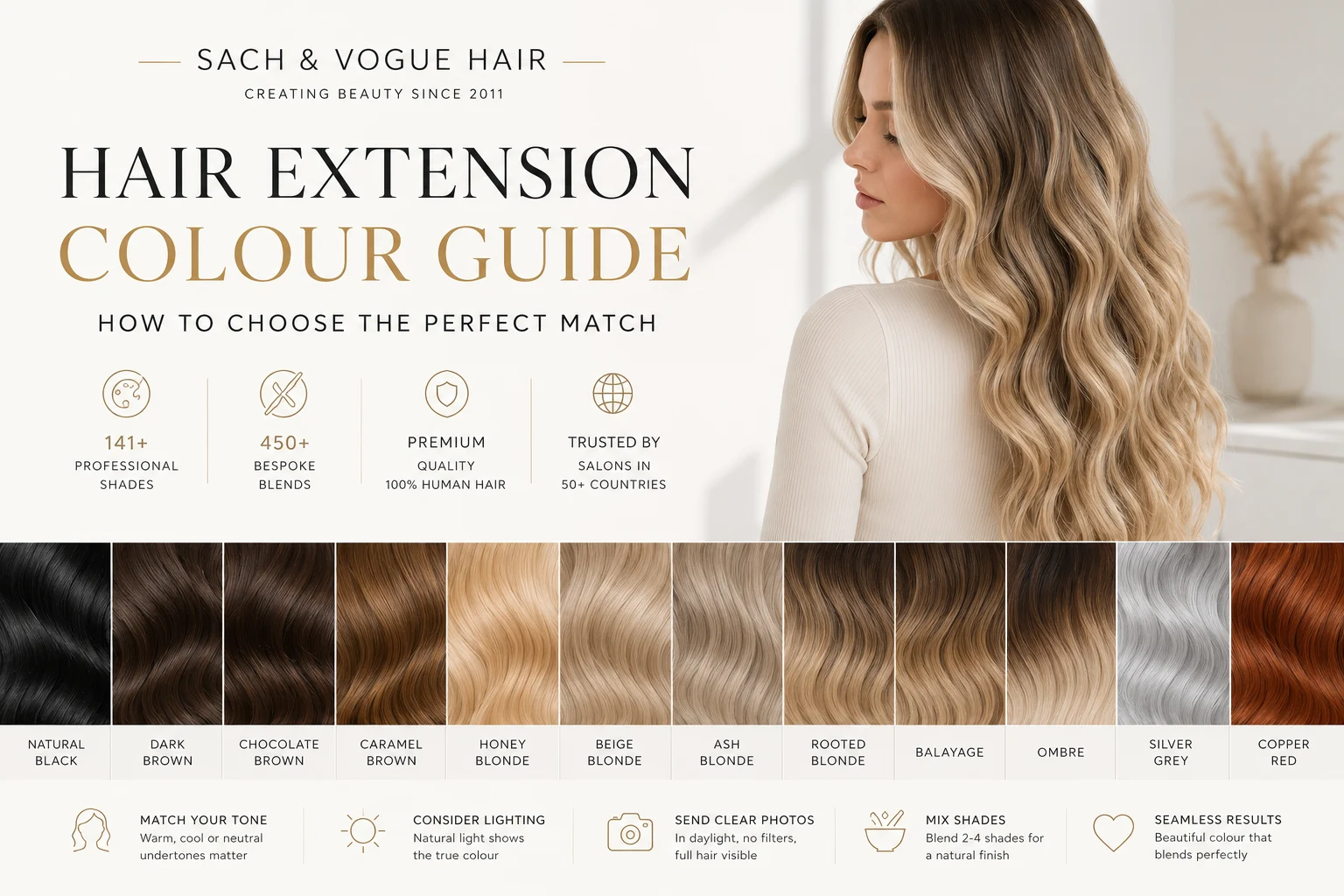
Creating Custom Hair Colours Since 2011
Choosing the correct hair extension colour is one of the most important parts of a successful transformation. Even premium human hair extensions can look artificial when the colour is wrong, while a carefully selected blend can make the extensions virtually disappear into the natural hair.
At Sach & Vogue Hair, we have been creating custom colour combinations for professional salons and private clients since 2011. Our colour library includes more than 141 standard shades and hundreds of bespoke blends prepared for customers around the world.
Professional colour matching is not simply a matter of choosing the nearest number on a colour chart. It requires analysis of the roots, mid-lengths, ends, undertones, previous colouring, light reflection and the final result the client wants to achieve.
Why Hair Extension Colour Matching Is So Important
Natural hair is rarely one uniform colour. It often contains darker roots, lighter ends, soft highlights, lowlights and subtle changes caused by previous colouring or sun exposure.
A professional colour match helps create:
- Invisible transitions between natural hair and extensions
- Natural depth and movement
- A more luxurious and dimensional finish
- Better blending in both daylight and indoor light
- A result that remains convincing when the hair moves
Understanding Hair Colour Levels
Hair colour levels describe how light or dark a shade is.
| Level | General description |
|---|---|
| 1 | Black |
| 2 | Soft black |
| 3 | Dark brown |
| 4 | Medium brown |
| 5 | Light brown |
| 6 | Dark blonde |
| 7 | Medium blonde |
| 8 | Light blonde |
| 9 | Very light blonde |
| 10 | Platinum blonde |
The level only explains lightness. Two shades can have the same level and still look completely different because their undertones are not the same.
Hair Colour Tone vs Hair Colour Level
Colour Level
Describes how light or dark the hair is.
Colour Tone
Describes the reflection inside the colour, such as ash, beige, neutral, golden, copper or pearl.
Common professional tones include:
- Ash
- Beige
- Neutral
- Natural
- Golden
- Honey
- Caramel
- Copper
- Auburn
- Pearl
- Silver
- Ice blonde
Warm Colours vs Cool Colours
Warm shades
Contain gold, honey, caramel, copper or red reflections.
Examples: golden blonde, honey blonde, caramel brown and copper brown.
Cool shades
Contain ash, pearl, silver or violet reflections.
Examples: ash blonde, mushroom brown, cool brown and ice blonde.
Matching a warm extension with cool natural hair, or the reverse, can produce a visible mismatch even when both colours appear to be the same level.
Single Colour vs Mixed Colour Extensions
Some clients need one shade. Many achieve a better result with two, three or more colours.
Single colour is often suitable for
- Solid black hair
- Uniformly coloured brunette hair
- Fresh salon colouring
- Virgin hair with little colour variation
Mixed colours are often better for
- Highlights and lowlights
- Balayage and ombre
- Rooted blonde hair
- Sun-kissed brunettes
- Multi-dimensional salon colours
Mixing shades creates realism, depth and movement. It is one of the main differences between a flat, budget-looking result and a premium salon transformation.
Professional Colour Library
141 Standard Shades, Plus Bespoke Colour Combinations
Our collection includes natural, ash, chocolate, cool and warm browns; Scandinavian, beige, pearl, golden and ice blondes; rooted, highlighted, balayage, ombre, grey and fashion shades.
Rooted Hair Extensions
Rooted hair extensions feature a darker colour at the top that gradually blends into lighter lengths. This recreates the natural way hair grows and makes lighter extensions look more realistic around the scalp.
Rooted colours are especially useful because they:
- Create natural depth
- Blend more easily with regrowth
- Reduce harsh colour transitions
- Make blonde results look softer
- Require less visual maintenance
Ombre Hair Extensions
Ombre extensions move from a darker colour near the top to a visibly lighter colour toward the ends. The transition is usually longer and more dramatic than a rooted colour.
They are ideal for clients who want:
- Brighter ends without colouring all their natural hair
- A long, dimensional brunette-to-blonde result
- A low-maintenance colour transition
- A more dramatic fashion effect
Balayage Hair Extensions
Balayage extensions imitate a hand-painted salon colour. Rather than using one uniform highlight pattern, they blend several shades through the lengths to create soft brightness and natural movement.
Professional balayage extensions may include a darker root, a neutral mid-tone, lighter ribbons and brighter ends. This makes them particularly effective for premium transformations.
Highlighted Hair Extensions
Highlighted extensions contain lighter strands distributed through a darker or neutral base. They are especially suitable for clients who already have conventional salon highlights.
Popular combinations include:
- Chocolate brown with beige blonde
- Medium brown with caramel
- Ash brown with cool blonde
- Dark blonde with platinum
- Natural brown with honey blonde
How to Match Blonde Hair Extensions
Blonde hair is often the most difficult to match because small differences in warmth, ash content or root depth become immediately visible.
Successful blonde matching considers:
- Overall level
- Warm, neutral or cool undertone
- Root depth
- Presence of highlights or lowlights
- Condition and porosity of previously coloured hair
- The colour of the natural ends
A platinum extension may look yellow beside an icy blonde. A warm golden blonde can look orange beside an ash blonde. The correct goal is harmony, not simply choosing the lightest available colour.
How to Match Brunette Hair Extensions
Brown hair contains more variation than many people realise. Premium brunette results often combine espresso, chocolate, mocha, ash brown, caramel and chestnut shades.
When the client's hair includes natural highs and lows, selecting only one flat brown can make the extensions look artificial. A carefully balanced combination produces more natural movement.
Natural Black, Jet Black and Blue Black
Natural Black
A softer black that can reveal subtle brown reflections in daylight.
Jet Black
An intense, deep black with greater visual density and richness.
Blue Black
A cool black with a subtle blue reflection under strong light.
These colours may appear similar indoors but can look clearly different in natural daylight.
Matching Red and Grey Hair
Red hair
Red shades reflect light strongly and include copper, auburn, cinnamon, mahogany, burgundy, cherry and wine tones. Daylight photographs are essential for accurate matching.
Grey and silver hair
Grey hair may include a mixture of white, silver, natural dark strands and cool reflections. A professional grey match may require two or more shades to reproduce the client's natural grey distribution.
How to Take Photos for Colour Matching
For the most accurate recommendation:
- Take photographs in natural daylight
- Avoid direct sunlight
- Do not use flash
- Do not use beauty filters or colour correction
- Photograph the back and both sides
- Show roots, mid-lengths and ends
- Keep the whole head visible in at least one photograph
Why indoor light can be misleading
Warm indoor lighting can make ash blonde look golden, while cool LED light can make natural brown appear greyer. Direct sunlight can make highlights look brighter than they really are.
Why screens show different colours
Phone and computer screens differ in brightness, saturation, colour temperature and display calibration. A colour seen on one device may look warmer, cooler, lighter or darker on another.
How Our Professional Colour Matching Service Works
- You send clear daylight photographs.
- We analyse the roots, mid-lengths, ends and undertones.
- We assess whether one shade or a multi-colour blend is needed.
- We recommend the most suitable standard or bespoke combination.
- We prepare the extensions according to your method, length and weight requirements.
Because we are a manufacturer, we can prepare custom combinations rather than limiting clients to a small pre-packed colour selection.
Custom Colour Orders
Custom colour ordering is particularly useful for clients who need a specific mixture of highlights, lowlights, root depth or tonal balance.
For example, a custom order may combine:
- 20 grams of one shade and 30 grams of another
- A darker rooted shade with lighter lengths
- A neutral base with selected ash or beige highlights
- A brunette foundation with caramel ribbons
The final combination is planned according to the client's natural hair, desired result and total gram requirement.
Common Hair Extension Colour Matching Mistakes
Matching only the roots
Extensions usually need to blend mainly with the mid-lengths and ends, not only the root colour.
Choosing only one shade
Highlighted, balayage or dimensional hair often needs a mixture of several colours.
Using filtered photos
Filters can change warmth, contrast and lightness, resulting in an inaccurate recommendation.
Ignoring undertone
A correct colour level can still look wrong when the natural hair is cool and the extension is warm.
Choosing from one photograph
One angle rarely shows the true relationship between the roots, mid-lengths and ends.
Planning colour without weight
The ratio of each shade must be calculated together with the total number of grams required.
Should Hair Extensions Be Dyed After Purchase?
We recommend choosing the correct colour before production whenever possible. Colouring extensions after purchase introduces unnecessary chemical processing and can shorten their usable life.
We do not recommend dyeing tape-in extensions. Dye, oils and chemical products can contaminate the adhesive area and weaken the tape.
Frequently Asked Questions
Should extensions match my roots or ends?
In most cases, extensions should blend primarily with the mid-lengths and ends. Rooted shades can be used when the natural root is significantly darker.
Can two or more colours be mixed?
Yes. Professional matching frequently combines two, three or more shades to recreate highlights, lowlights, balayage or natural dimension.
Can you match my colour from photographs?
Yes, provided the photographs are taken in natural daylight without filters, flash or direct sunlight.
Do you create custom colour combinations?
Yes. We offer 141 standard shades and bespoke colour combinations for private clients and professional salons.
Can I order different gram amounts in different colours?
Yes. Custom orders can divide the total weight across multiple shades according to the desired blend.
Why does the same colour look different on my phone?
Screens vary in brightness, colour temperature, saturation and calibration. This is why daylight photographs and expert assessment are more reliable than screen comparison alone.
Can tape-in extensions be dyed?
We do not recommend it. Chemical colour can affect the hair and contaminate the tape adhesive area.
Professional Colour Matching
Send Us Your Hair Photos
Our specialists can assess your roots, mid-lengths, ends and undertones, then recommend the most suitable standard shade or custom colour combination.